
If you curse bedtime, have a cranky child, or just don't know how much sleep they really need, read on
Quick Navigation
Sleep Tips
Have you ever pulled an all-nighter? Maybe you stayed up studying into the wee hours of the morning. Or maybe your twenty-first birthday party was a raging success, and you partied hard enough to watch the sun rise. You probably took it pretty easy the next day — after your exam, or a bacon-egg-and-cheese sandwich, of course. Let’s face it — you were tired.
Tired.
The word tired takes on an entirely new meaning when you have kids. No amount of studying, or partying, or working late holds a candle to the exhaustion that comes with raising little ones. It is a whole new level of tired. No — a whole new universe of tired. The kind that makes your bones ache, your brain foggy, and your temper short. The kind that makes you put your car keys in the freezer and fill your baby’s bottle with coffee instead of milk.
And if that’s not bad enough, there is no such thing as “taking it easy” the next day. Parents don’t get sick days. Try telling your hungry baby that you’re “taking it easy” for the day and see how that turns out.
Solving the Sleep Problem Together
We know how much you love your precious angels. Your kids aren’t demons for stealing your sleep. It’s just what they do. And the good news is, you’ve got some pretty cute tiny humans to show for it, despite the fact that sometimes you’re too tired to remember their names. And rest assured — you’re not alone. We parents are in this together.
That’s why we’ve put together this guide: your one-stop-shop for all things baby-and-child sleep-related. They say it takes a village, right? Consider us your nightly next door neighbors. This is a hefty topic, so we’ve broken things down into sections you can skip between:
- The Impact of Insufficient Sleep
- The Good, The Bad, and The Ugly
- Important Notes About This Guide
- Safe Sleep with Infants
- Establishing a Healthy Bedtime Routine
- How Much Sleep Should Kids Get?
- Sleep By Age Group
- Tips for Dealing with Problems
DANGER, WILL ROBINSON
Sleep deprivation is a very real and very scary thing. According to the National Sleep Foundation, “sleep deprivation can have similar effects on your body as drinking alcohol.” In fact, in a 2000 sleep studycomparing the effects of sleep deprivation with those of alcohol consumption, nearly 75% of participants fared worse on tasks measuring reaction time, vigilance, and the ability to multitask when they were sleep deprived than when they were nearly legally drunk.
Mothers whose children (now preschool-aged) had [persistent] or [recurring]…infant sleep problems in the preschool years [had] higher depression scores.
One of the biggest potential consequences of sleep deprivation is the onset of postpartum (and beyond) depression. The link between lack of sleep and depression is well-documented. In a 2001 study of nearly one thousand new mothers, researchers found “a strong association between [infant sleep problems and depression symptoms].”
A follow-up 2003 study returned to check in on those same mothers and their children. The results? The mothers whose children (now preschool-aged) had “[persistent] or [recurring]…infant sleep problems in the preschool years [had] higher depression scores.” The children were worse off, too, with “child behavior problems” noted. With similar results being replicated in a 2005 study, it’s no secret that sleep deprivation is a danger to new and seasoned mothers alike — as well as the children under their care.
Sleep Deprivation’s Impact on Our Kids
Sleep deprivation is bad for your child, too. If your baby or child is up one hundred times a night, or refuses to nap, or takes hours to fall asleep, chances are they’re sleep-deprived, too. And contrary to popular belief, tiring a baby or child out so they’ll sleep deeper and longer at night is NOT a good strategy. Sleep begets sleep. If your child is overtired and hasn’t gotten appropriate rest during the day or previous nights, they (and you) are probably in for a terrible night of sleep ahead.
And that’s not even the worst of it — a 2011 review of the existing literature on sleep deprivation in children confirmed what has long been believed to be true: “inadequate sleep quality and/or quantity can cause sleepiness, inattention and, very likely, other cognitive and behavioral deficits that significantly impact children and adolescents in functional settings.”
THE GOOD, THE BAD, AND THE UGLY
Some babies are born ‘sleepers’ and some are not. Some babies have more difficulty learning to fall asleep, are more easily aroused from sleep, and are more sensitive to changes in routines that affect their sleep patterns.
We’re going to go a bit out of order here and start with the bad: when your kid was born, they came out of the womb with a certain “style” of sleep. Lots of people will give you advice that suggests otherwise — things like formula-fed babies sleep better and longer, or that putting rice cereal in their bottle will make them sleep through the night — but the fact is, it’s pretty much luck of the draw. Jodi Mindell, PhD and author of Sleeping Through the Night, confirms as much: “some babies are born ‘sleepers’ and some are not. Some babies have more difficulty learning to fall asleep, are more easily aroused from sleep, and are more sensitive to changes in routines that affect their sleep patterns.”
Chances are, if you popped out one of those cherubs that fights sleep like the plague, you’ve had some pretty choice words fly out of your mouth while waking up at 4:00 AM for the fifth time in three hours (that’s the ugly).
A PROBLEM WITH MANY SOLUTIONS
The good news is that most babies don’t understand the string of four-letter words you’ve woven into their lullaby.
The better news? Regardless of your baby’s sleep tendencies, there are PLENTY of tips, tricks, methods, and strategies to help your child become a better sleeper over the course of their life. You are not doomed to a life of bloodshot eyes and dark circles. In fact, Mindell says, “babies learn to fall asleep under specific circumstances…many babies develop good sleep habits, whereas other babies develop poor sleep habits [emphasis ours].” This should give you a ray of hope; regardless of the way your baby entered this world, you can help her learn and develop good habits over time.
But first, it’s important to have a solid understanding of childhood sleep — why it’s important, what’s “normal,” general best practices, how to ensure your child is sleeping safely, and some common issues lurking just around the corner as you close Goodnight Moon and turn off the light.
IMPORTANT NOTES ABOUT THIS GUIDE
Much of this guide is broken up by age group, so feel free to jump around and take what works for you right now. Be sure to bookmark this page — we’ll still be here when your one-year-old night owl becomes a tantrum-loving threenager (yeah, that’s a thing), and then again when they’re a REAL teenager, and we’ve got tips for them, too.
Also to note: we’ve searched far and wide and pulled from the latest and best research to include strategies to fit just about any parenting style to which you might subscribe. Childhood sleep development is a hot-button topic, and we’re not here to tell you that there’s one right way to make it work for you. For each age group and each sleep issue we’ll talk about in this guide, we’ve included tips and tricks that run the gamut from attachment-style methods, to more traditional “sleep training” ideas. Neither one is right or wrong — it’s all about what’s right for you and your child so that everyone in the family gets the sleep they need.
Most Important: Safe Sleep
Safe sleeping habits are especially important in infancy in order to lessen the risk of Sudden Infant Death Syndrome (SIDS).
The very first thing you need to do to help your child sleep well is to ensure they’re sleeping safely. Safe sleeping habits are especially important in infancy in order to lessen the risk of Sudden Infant Death Syndrome (SIDS), but there are safety factors you should consider for every age group.
The American Academy of Pediatrics published their updated recommendations for safe infant sleep in a 2016 study. Their guidelines include the following:
- Infants should room-share with separate bed surfaces for the at least the first six months of life
- Infants should always be placed to sleep flat on their backs
- Sleep surfaces should be firm, such as a crib or bassinet, and covered with a single, tight-fitting sheet
- Sleep enclosures (bassinets, cribs) should be empty — no bumpers, blankets, pillows, stuffed animals, or other comfort items
Light, breathable blankets can be introduced after age one, and pillows are okay to try at around age two or three.
For older children, especially those who have moved out of an enclosed sleeping space, it’s very important to make sure the room in which they sleep is child-proofed.
- Cover all unused electrical outlets (outlet guards and wire guards are best)
- Place blind/shade pull-strings out of reach (better yet — use cordless window coverings)
- Consider installing window guards
- Child-proof the bedroom door by removing interior locks and installing a door guard
- Install smoke and carbon monoxide detectors
- Anchor all furniture to the wall
- Keep breakables out of reach, or remove from child’s bedroom altogether
Know Your Routine: The First Step in Improvement
Having a routine in place helps babies and children fall asleep more quickly, go back to sleep more easily when they wake up, and improves moms’ moods to boot.
If there’s one thing that unites children around the world, regardless of culture, background, or age, it’s that they thrive on routine. Very few children cope well with unpredictability.
This concept holds especially true for bedtime. Do a quick search for “bedtime routine” on any mom blog or parenting forum, and you’re likely to find thousands of responses from parents who think they’ve discovered (or are desperately searching for) that magic combination of steps before bedtime to make the process easier on everyone.
The idea of routine isn’t just a mom-blog myth, either; it’s backed up by years of research-driven data. As usual, our girl Jodi Mindell sums it up perfectly in her 2009 study: “Instituting a consistent nightly bedtime routine, in and of itself, is beneficial in improving multiple aspects of infant and toddler sleep, especially wakefulness after sleep onset and sleep continuity, as well as maternal mood.”
To put it plainly? Having a routine in place helps babies and children fall asleep more quickly, go back to sleep more easily when they wake up, and improves parents’ moods to boot.
CUSTOMIZE YOUR BEDTIME ROUTINE TO YOUR CHILD
If you don’t have a routine in place yet for your little one’s bedtime, start experimenting. Different things work better or worse for different children. Does your baby hate bath time with a passion? Probably best to skip the splashing just before bed. Potty-training or dealing with bed wetting? Might be better to forego the bedside glass of milk for a while.
We’ve come up with a list of routine components for you to try with your little one. You can go as bare-bones or done-up as you want; it all depends on what works best for your family. Finding the right routine will almost definitely take trial and error, but don’t give up — once you find the magic combination, everyone will start catching more shuteye soon enough.
Basic Bedtime Routine Components
- Food. Whether you’re nursing or formula feeding an infant, or wrangling a hungry toddler who’s fully weaned, you might want to consider a bedtime feed or snack. Some babies do great falling asleep with a full belly, and others get too gassy. Play around with different timings to see what works best.
- Books. This one will look a bit different for everyone depending on the age of your little one. For infants, it’s best to use the same book each time you read to them before bed. Feel free to read a wide variety throughout the day, but sticking to one book before bedtime will help your baby’s brain get ready to go to sleep. Older children, on the other hand, might enjoy choosing a different book each night. Switching things up this way is perfectly fine — as long as you keep routine in mind. Reading two books one night and six books the next will be confusing for your child and prolong the bedtime process.
- Bath. Again, this won’t work for every child. Younger babies, in particular, tend to be persnickety about their love or hatred for the water. If your baby screams his way through the suds, don’t do it before bed. You want your routine to be calm and positive.
- Bathroom. This one seems obvious, but you’d be surprised how it can get overlooked after a busy day. Make sure your baby goes to bed with a clean, dry diaper, and your older child uses the bathroom right before hitting the hay. They may still need a change or to get up in the middle of the night, but giving them the chance right before turning in should deter your little ones from the “But-I-have-to-pee!” excuse when all else has failed.
- Teeth. As soon as your baby starts sprouting teeth (you’ll know this one’s coming when — surprise! — your little one starts waking up more frequently at night), it’s important to get in the habit of brushing their pearly whites. In fact, you can even start before the teeth come through by gently brushing their gums.
- Lullaby and/or Prayer. Choose songs or prayers that have special meaning to you both. Try to choose ones that are quiet, low-energy, and uplifting.
- Snuggle. This one can come back to bite you if you take it too far, so pay attention to how this goes for you and your little one. While snuggling your baby or child until they fall asleep has the potential to go south (are you prepared to get up and snuggle your newborn every time they wake those first few months?), it’s perfectly okay to cuddle up next to them for a few minutes while they get comfy in bed.
Your routine can include some or all of these components, plus whatever else you and your little one decide upon together.
What To Expect (Now That You’re Not Expecting)
One of the tricky things about addressing your child’s sleeping habits is that you’re often working with a moving target. Babies and children require different amounts of sleep — and at different times throughout the day — to remain healthy. Sleep Health: The Journal of the National Sleep Foundation, conducted a rigorous study in 2015 to update the National Sleep Foundation’s sleep duration recommendations. We’ll dive into their findings (outlined below) in greater detail in this section. Overall, here’s what a typically-developing child needs in terms of sleep in a 24-hour period, by age:
- Newborns: 14 – 17 hours
- Infants: 12 – 15 hours
- Toddlers: 11 – 14 hours
- Preschoolers: 10 – 13 hours
- School-aged children: 9 – 11 hours
- Teenagers: 8 – 10 hours
If you’re doing some groggy math in your head and realizing that your child is definitely not getting the sleep they need, read on. Knowledge is power. The more you know, the more you can help.
Newborns: 0 – 4 Months
Your baby’s ability to sleep more at night than during the day has nothing to do with being confused; instead, it has everything to do with how their brains and nervous system develop over time.
Newborns are the biggest wild card when it comes to sleep. The truth is, they don’t know up from down, night from day, or anything in between — and to be honest, your job is to be okay with that. Try your best to with the flow for about the first four weeks.
If your newborn squish is awake during the night more than they are during the day, a lot of well-meaning folks will tell you it’s because they “have their nights and days mixed up.” This is partially true…but it’s not something you should want to (or can, for that matter) fix. Not right away, at least.
Think back to your pregnancy (feels like ages ago, doesn’t it?). Once you started feeling baby movements, you might have noticed that your baby was less active during the day, but would start his tap-dancing routine just as you laid your head down for the night. That’s pretty common. The motion of mom’s movement tends to rock babies to sleep in the womb. When the motion stops, many babies like to wake up to get their calisthenics in. So, in some respects, your well-meaning great aunt kind of knows what she’s talking about — your baby is somewhat used to waking at night and sleeping during the day. But there’s a bit more science behind it.
In a 1964 study, researchers found that there was little change in the number of hours spent sleeping over a 24-hour period during infants’ first 16 weeks of life. However, by the end of the sixteenth week, “the distribution of sleep showed double the amount of sleep at night as compared to the day.” This means that your baby wasn’t actually “mixed-up” during her first few weeks of life — it’s perfectly normal for newborn sleep to happen in smaller increments dispersed throughout a 24-hour period, rather than bunched up more during the night. In fact, the study found that the shift in sleeping from a scattered pattern to a more night-based one “coincide[d] with reported maturational changes in behavior and electroencephalograms, and with anatomic changes in the nervous system.”
Plain English? Your baby’s ability to sleep more at night than during the day has nothing to do with being confused; instead, it has everything to do with how their brains and nervous system develop over time.
WHY NEWBORNS NEED SO MUCH SLEEP: LIFE IS HARD
The main reason newborns sleep for much of the day is pretty simple: life on the outside is hard. Literally every sound, sight, and touch is completely new to your baby. His brain is working at rapid speed to understand all of this newness, and sleep is a key component in that process.
In fact, your baby’s brain is working triple duty while he sleeps. First, your baby’s brain is maturing while he’s asleep. That increased maturity helps him become more prepared to process newer and more sophisticated information while he’s awake. Second, your baby’s brain consolidates memories while he’s sleeping. This is true for adult brains, too. Lastly, new research is beginning to show that your baby’s brain actually continues to intake and process new stimuli, even while asleep. With everything around them being new and noteworthy, it’s no wonder your baby needs to doze off so frequently.
While many new parents can be shell-shocked at their new take-it-when-you-can-get-it sleep situation, many others worry that their baby sleeps too much. According to The Baby Sleep Site, it’s unlikely your little one’s all-day napfest is harmful: “Unless your baby literally never wakes up, not even to eat, there is most likely no reason to worry your baby is sleeping too much. In the first few weeks, it’s also very common for you to need to wake your baby every 2 – 3 hours to ensure he eats, and he may go right back to sleep afterward.” However, if you’re concerned, it’s never a bad idea to give your pediatrician a ring to double check (just be prepared for them to tell you to enjoy the sleep while you can!).
One last thing before we get into the nitty-gritty. Regardless of where you fall on the sleep-training spectrum, the newborn stage is not the time to try any drastic tactics. Your baby is still learning about the world, and about you, and your job is to respond to their needs as quickly as you can during this stage — day or night.
TYPICAL NEWBORN SLEEP PATTERNS
According to Stanford Children’s Health, “newborns generally sleep about 8 to 9 hours in the daytime and about 8 hours at night.” These periods don’t happen all at once, though — nor should you want them to. Newborn stomachs are only about the size of a marble, which means they don’t hold much. You want your baby to eat about every 2 – 3 hours (or more frequently, if they request it), so be sure to wake your baby up for a feed if they’re approaching that threshold.
Other than that, there is no real “pattern” of newborn sleep. Some newborns sleep and wake for short cycles; others will take a monster, four-hour nap if you let them. As long as they’re taking in enough food throughout a 24-hour period, there generally isn’t much to worry about.
COMMON DISRUPTORS OF NEWBORN SLEEP
Most newborns, when actually sleeping, are deep sleepers. In fact, most parents are pleasantly surprised when they find that their newborn can seemingly sleep through anything (until 3:00 AM, of course). There are, however, a few issues that some unlucky parents run across when navigating their new tiny human’s sleeping patterns.
COLIC
There’s no debate here: parents of colicky babies deserve a medal, all the coffee, all the wine, and a week-long spa vacation.
Colic describes a phenomenon in which newborn babies cry a lot. For most parents, even five minutes of hearing their baby cry, seemingly without reason, feels like an eternity. But it doesn’t mean you’ve got a colicky baby on your hands. According to Dr. Harvey Karp — pediatrician, assistant professor of pediatrics at University of Southern California, and expert in colicky babies — your baby is most certainly going to cry (probably a lot!) in at least their first few weeks of life, “and that’s a good thing. How else would we know if our helpless infants were cold, hungry, lonely, or in pain?”
However, a colicky baby is something different. Karp defines an infant with colic as one who “cries for more than 3 hours a day, at least 3 days a week, and consistently for longer than 3 weeks.” These babies will cry as if being tortured, for hours on end, despite being fed, changed, and cuddled.
DEALING WITH COLIC
If you’re the parent of a colicky baby, don’t worry. “We now think of colic as being part of normal development,” says Dr. Ian St. James-Roberts, expert in child development. It doesn’t mean you’re doing anything wrong, and it won’t last forever. Colicky behavior typically begins at around 2 weeks of age, and ends at around 4 months. It totally sucks…but there’s nothing wrong with your or your baby.
In the meantime, there are things you can do to try to ease the screams. First, it’s important to bring up your concerns to your pediatrician and rule out any underlying medical issues. If all looks healthy and colic is indeed the cause, try using a combination of Karp’s “Happiest Baby on the Block” routine. Karp suggests mimicking the environment of the womb by offering your baby the 5 S’s: swaddling, side or stomach position (note: this is NOT for a sleeping baby; only lay an awake baby on their side or stomach), shushing, swinging, or sucking.
JAUNDICE
On the opposite end of the sleep-issue spectrum is jaundice. Jaundice occurs when bilirubin levels in the body are too high. Jaundice comes on a spectrum, and being on the lower end is relatively common at birth. Mild cases of jaundice are often resolved once baby starts eating and going to the bathroom regularly, but in some cases (like difficulty latching and transferring milk, for example) bilirubin levels will continue to rise after birth. High bilirubin can make babies extremely sleepy, making it difficult for them to wake long enough for a proper feeding.
Your baby’s bilirubin will be monitored from birth. However, if you notice that your baby seems unusually sleepy, refuses to wake for feeds, and/or has an orange tint to their skin, be sure to give your doctor a call right away.
BEST PRACTICES FOR NEWBORN SLEEP HABITS
When your newborn wakes in the middle of the night, try to keep the lights dim and sounds low. Just because your newborn doesn’t have a schedule doesn’t mean they aren’t learning.
The best piece of advice we can offer for the newborn stage is somewhat contradictory, so bear with us.
While it’s important to give your newborn the sleep he needs when he needs it, as well as the food he needs when he needs it, it’s also important to start implementing some kind of routine as soon as possible. You could choose a bedtime book, for example, and start reading it to your baby at roughly the same time every day. That way, as your baby approaches the four-month mark and things start to normalize a bit, your baby will already know what to expect.
You’ll also want to try your best to keep your family’s days and nights on track as much as possible. When your newborn wakes in the middle of the night, try to keep the lights dim and sounds low. Just because your newborn doesn’t have a schedule doesn’t mean they aren’t learning. The earlier you can introduce the idea of night and day, the better. But be patient with your baby as they figure things out — after the first couple of months, your routine will pay off, and your schedule will start to feel slightly more normal.
Infants: 4 – 12 Months
Babies wake up during the night. It’s just what they do. What you do about it, and what your baby learns to do about it, are what matter.
Here’s where things get really interesting. Whereas with newborns, who are completely reliable in that they have no reliable schedule whatsoever, infants like to change things up — a lot.
Some babies outgrow the newborn stage and become champion sleepers right out of the gate. We call these Unicorn Babies, and they do exist. They are easy to put down to sleep, take long naps, put themselves back to sleep if they wake, and wake up in the morning happy. If you have one of these babies, count yourself lucky (and please watch our baby while we take a nap).
On the other hand, if bedtime with your infant has you dreaming about an exorcism, or you find yourself driving around in your pajamas with your baby in the backseat at 3:00 AM, you’re not alone.
Babies wake up during the night. It’s just what they do. What you do about it, and what your baby learns to do about it, are what matter.
Bedtime and nighttime with your baby should not be difficult. Ideally, your baby should fall asleep easily and with increasing independence, and should learn how to put himself back to sleep if and when he wakes in the middle of the night with little to no interference from you.
Arriving at this ideal looks different for each baby and family; for some, it can be quite a journey. The key to remember is that the components of your nighttime routine don’t matter as much as the overall success of the routine itself. Do you spend hours rocking your baby to sleep, only to start the process over again in an hour? That’s not working. On the other hand, Mindell says, “many babies who are rocked or nursed to sleep go to sleep quickly, and don’t wake during the night…the same parenting behavior can lead to sleep problems and babies and not in others.” If you nurse, rock, shush, and pat to sleep, and your baby is out like a light for the next 12 hours — more power to you. However, “parents need to change their behavior…if their baby has a problem sleeping through the night,” or putting himself back to sleep after waking in the middle of the night.
ON YOUR TOUGHEST NIGHT, REMEMBER THIS: YOUR BABY NEEDS SLEEP
Babies go through a tremendous amount of change, mentally and physically, and they need adequate rest to develop properly.
When you’re sleep-deprived, it can be tempting to throw your hands up and let your baby sleep wherever and whenever they happen to crash, but it’s important to use the infant stage to start teaching them good sleep habits.
Just like the newborn stage, the infancy period is absolutely chock full of new experiences. Babies go through a tremendous amount of change, mentally and physically, and they need adequate rest to develop properly. Over the course of her first year, a typically developing baby will learn how to: hold her own head up; roll (both ways); grab things with her hands and fingers; crawl; find your voice in a crowd; clap; wave; smile; laugh; get your attention; point to something interesting; eat solid food; grab her feet; grow teeth; recover from illness; some will learn how to walk and talk; and master countless other milestones. It’s a busy year, to say the least. None of that can happen without the right amount of sleep.
That being said, let’s take a look at the development of ideal sleeping patterns for babies under one year old.
INFANT SLEEPING PATTERNS: A MOVING TARGET
As your baby gets older, his daily sleep needs will decrease, and his maximum awake time between sleep periods will increase. Number and length of naps will shift over time, and bedtime will change. As if you don’t have enough to think about…
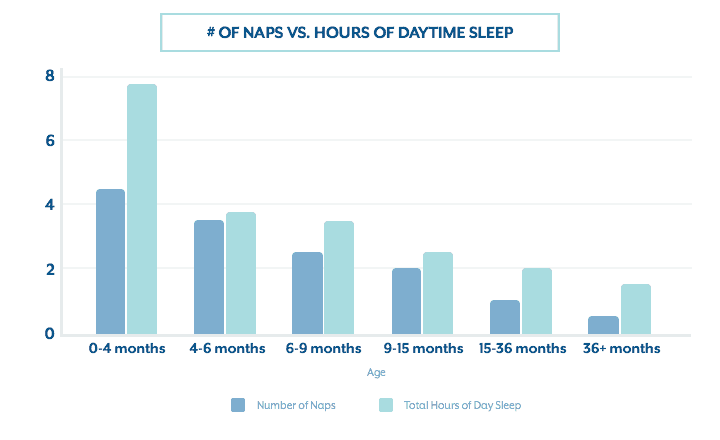
In order to know when it’s time to transition from one sleep stage to the next, pay attention to your baby’s tired cues. Picking up on tired cues is important, says Kim West, author of The Sleep Lady’s Good Night, Sleep Tight, because if you miss them, “[your baby’s] body won’t be pumping out calming melatonin. Instead, his adrenal glands will send out a rush of cortisol, a stress-related hormone that will overstimulate your baby…and create a second wind.”
Common tired cues include:
- Yawning
- Rubbing eyes
- Decreased play
- Whining or fussing
Pay careful attention to the clock and your baby’s cues — don’t let either one by itself dictate his schedule.
WHAT’S THE MATTER NOW? THE (LONG) LIST OF REASONS YOUR INFANT CAN’T SLEEP
As we mentioned, infancy is a busy and sometimes difficult time in the life of your child. A remarkable amount of growth and learning occurs during the first year of life, and all that development can make it difficult to get some shuteye. (It’s the same for adults, by the way, so cut your baby some slack. Have you ever had a really busy week and just can’t seem to wind down on Friday night? Or maybe you’ve changed jobs, and the sudden influx of new information keeps you tossing and turning? It’s just like that for babies, only amplified times, like, a million.) Here are some typical reasons your baby may be having trouble sleeping.
LEAPS
Although researchers have been studying this phenomenon for years, it’s a relatively new concept in mainstream child-rearing: Wonder Weeks.
Authors of the best-selling book The Wonder Weeks: How to Stimulate Development and Help Him Turn His 10 Predictable, Great, Fussy Phases into Magical Leaps Forward confirm that “it’s not your imagination. All babies go through a difficult period around the same age. Research has shown that babies make 10 major, predictable, age-linked changes — or leaps — during their first 20 months of their lives. With each leap comes a drastic change in your baby’s mental development, which affects…his sleeping patterns,” among other things.
When your baby is in the middle of a leap, you can expect their sleep to be disrupted in some way. They may sleep more or less during night time; they may fight naps tooth and nail, or they may nap for shorter or longer than usual. But along with a leap almost always comes a curveball when it comes to sleeping.
SLEEP REGRESSIONS
You can expect your baby to go through lots of ups and downs in their sleep patterns over the course of their first year
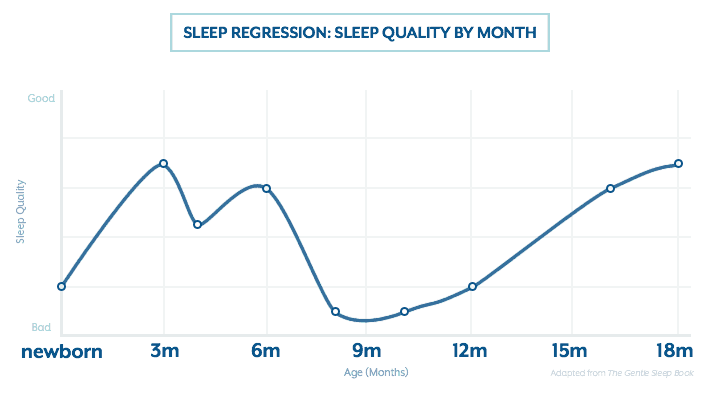
Ah, sleep regressions. This is one of those topics that seasoned parents just love to talk about with new parents. It’s like some sort of strange schadenfreude/commiseration technique. Pam Edwards, pediatric sleep consultant, says that “the ‘ 4-month sleep regression’ has celebrity status” in her business.
“A sleep regression,” Edwards says, “is thought to occur when a baby who is normally sleeping well begins to wake frequently at night and/or fights/refuses naps. These regressions seem to come out of nowhere and can last indefinitely.”
That’s definitely disheartening. There’s nothing like being three months into parenting, finally thinking you’ve got everything figured out, and then — BAM — your baby is up all hours of the night again.
Sarah Ockwell-Smith, author and parenting expert, expands on this idea of sleep regressions: “[society seems] to think that baby sleep is linear…that it gets better as babies grow older. Or at least we believe it is static, i.e. it won’t get worse again.” Not true, says Ockwell-Smith. You can expect your baby to go through lots of ups and downs in their sleep patterns over the course of their first year. “Yes, it is depressing,” she says, “but it’s realistic and once you know that something is totally normal, not your fault, and most importantly not permanent it is so much easier to relax a little.”
According to Pam Edwards, the key to surviving regressions is simple.
“It is all about recognizing our baby’s changing needs and having a flexible schedule that is in sync with our child’s natural sleep rhythm. We as parents may think that because we started one way (by always nursing to sleep, by rocking to sleep, by holding baby for all sleep) that this is the way that baby will always need to sleep. This is definitely not the case! When these things stop working we need to switch it up and find something new to help our babies get the sleep they need.”
EAR INFECTIONS
A less widespread, but still common sleep inhibitor is recurring ear infections. Many little ones are prone to these nasty, painful suckers and they can be a HUGE issue when it comes to getting good rest. When fluid builds up in the ear, it makes laying down extremely painful.
Look out for the following symptoms to determine if your little one may have an ear infection:
- Pulling, rubbing, grabbing, or tugging on their ears
- Diarrhea or vomiting
- Reduced appetite
- Drainage from the ear
- Difficulty sleeping
These days, pediatricians are hesitant to prescribe antibiotics for ear infections and typically advise you to let the infection run its course. However, it’s still important to have your little one checked out by their doctor if you suspect an infection. In severe or recurring infections, it’s likely they’ll be prescribed medicine to clear it up.
TEETHING
Unlike ear infections, which only affect an unlucky subset of babies, teething is going to hit every family at one time or another. Even more annoying? Children will grow 20 baby teeth, and it will take them up to three years to do so. Ugh.
Most babies get their first tooth at around 8 months of age, though some can sprout as early as 3 months (and, though rare, there are cases of babies being born with teeth…whoa).
Symptoms of teething include:
- Drooling
- Teething rash/redness on face and chin
- Refusal to eat
- Biting
- Fussiness
- Ear/cheek rubbing
- Difficulty sleeping
According to The Baby Sleep Site, there are three major ways you can help your little one as that next tooth works its way up through the gums.
- Teething Toys Popular choices include freezable objects, as well as those with texture to soothe raw gums. Don’t be afraid to go old school here, either — a frozen washcloth works perfectly in a pinch!
- Tylenol or Ibuprofen Just pay attention to the appropriate dosage information.
- Comfort As Needed Your baby is in pain — they deserve to feel comfortable. Just be wary of undoing any sleep progress you’ve made by indulging in bad habits. Did you spend two months trying to get your little one to sleep in her crib? Probably best to avoid co-sleeping during teething periods. Instead, opt for a nice cuddle and lullaby, and then place your baby back in her crib.
SO MY BABY HAS MORE PROBLEMS THAN A JAY-Z SONG…HOW WILL I GET ANY SLEEP?
Like we said — the infant stage is a challenging time when it comes to sleep. And there’s no shortage of advice, either. It can be hard to know where to turn and what feels right for your family. We’ve consolidated some of the most common expert advice out there, and weighed in on the pros and cons of each. It’s up to you to decide what will work best for your family.
EXTENDED CO-SLEEPING
Regardless of how or when it happens, it’s important to bed-share safely if you choose to do so.
Up first on our list of (controversial) advice is the concept of extended rooming-in and/or bed-sharing with your baby.
According to Mama Natural, a popular attachment-parenting blog, “cosleeping with baby is culturally accepted in many non western [sic] societies today.” Many parents believe that sleeping in close quarters with their baby helps everyone get more sleep by making night feeds more efficient and reducing separation anxiety.
Though the AAP vehemently recommends against bed-sharing, there are many families who do so — whether they admit it or not. Some families make it a habit, and some find themselves next to baby out of desperation. Regardless of how or when it happens, it’s important to bed-share safely if you choose to do so. Adhere to the following guidelines to ensure the safest possible bed-sharing environment for your little one:
- Baby should sleep closer/next to mom (rather than dad)
- Bed-sharing is safest for breastfed babies
- Baby should be placed to sleep on her back, on a firm mattress with a tight-fitting sheet
- Absolutely NO loose blankets, pillows, or sheets near baby’s face
- Leave no space between the mattress and the wall where baby could potentially roll into
- DO NOT bed-share on a couch or recliner, or anywhere other than a bed
- Parents who smoke, drink, or take drugs (prescribed or otherwise) should not bedshare
- Bed-sharing babies should not be swaddled
- Consider the temperature of your little one, as bed-sharing tends to create warmer sleeping conditions for baby
NOTE: Bedsharing is absolutely NOT recommended by the AAP due to studies linking it to SIDS.
Many families find a middle ground when it comes to co-sleeping by using “arms-reach” sidecar sleepers, or placing baby’s crib next to their bed for an extended period of time.
Co-sleepers beware: aside from safety concerns, there are many experts in the sleep world that also consider co-sleeping/bed-sharing to be an unnecessary “sleep crutch.” Many believe that by co-sleeping, you are denying your baby the ability to develop healthy, independent sleep habits. Even proponents of bed-sharing acknowledge that you’ll be in it for the long haul if you go this route — bed-sharing with your child is sometimes referred to as a “five-year plan.” This isn’t to say that you can’t get baby out of your bed if you decide to stop bed-sharing before five years, but it may be significantly more difficult than not bringing your baby in bed at all.
THE WONDERFUL WORLD OF “SLEEP TRAINING”
Next on our list of (again, controversial!) advice are three of the more popularly-discussed “sleep training” methods. When people think of sleep training, they typically assume it involves letting their baby cry for some period of time. While it’s true that many methods involve “crying it out,” there are others that aim for baby to cry as little as possible.
We’ll dive into a few specific strategies here, but remember: take what works for you and your baby, and tweak as needed. There is no one-size fits all.
THE FERBER METHOD
[With the Ferber Method], the key is to always leave the room while baby is still awake
Dr. Richard Ferber, director of The Center for Pediatric Sleep Disorders, developed his sleep-training method with one goal in mind: wean your baby away from his sleep associations to help him develop the ability fall asleep on his own.
The basic premise is simple enough. Go through your nightly routine, make sure your baby is fed and comfortable, and put him to bed drowsy, but still awake. Then leave the room.
For most babies, you can probably expect a fair bit of fussing at first. Ferber advocates for checking in on your little one and reassuring